
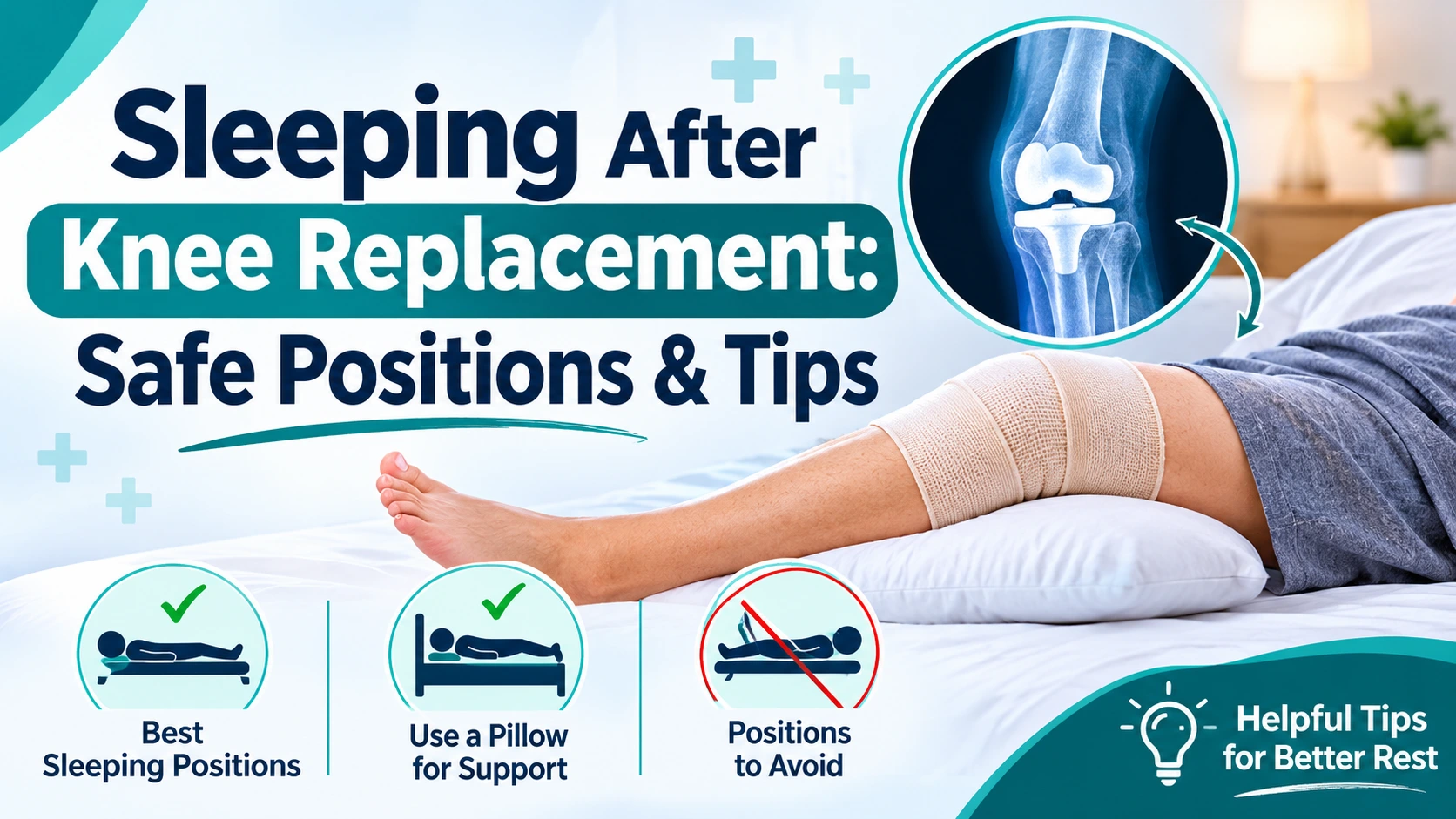
Sleeping After Knee Replacement: Safe Positions and Tips for Better Rest
By Dr. Anuj Jain, M.B.B.S., M.S. (Orth), D.N.B., MNAMS Published and last updated: 14 November 2026.
Many patients in Noida and Delhi NCR tell us the same thing a few days after surgery: the operation went well, but the nights are hard. Pain, swelling, stiffness and fear of "sleeping wrong" can make rest difficult. The good news is that sleeping after knee replacement becomes easier with a few simple adjustments, and poor sleep in the early weeks is common and usually improves as the knee heals. This guide explains safe sleeping positions after knee replacement, how to manage night-time discomfort, and when to contact your doctor. If you want to understand the operation itself first, you can read about total knee replacement.
Please note: advice differs from patient to patient, depending on the type of surgery, the implant, your overall health and your surgeon's protocol. Always follow the instructions given by your own surgeon and physiotherapist.
Why is sleep difficult after knee replacement?
Several factors can disturb sleep in the first few weeks:
- Pain and swelling that often feel worse at night, when the leg is still and you have fewer distractions
- Stiffness after lying in one position for a long time
- Difficulty finding a comfortable position, because the operated knee cannot be bent or twisted freely at first
- Pain medicines, change in routine and hospital stay, which can upset the normal sleep pattern
- Worry about damaging the new joint
Good rest matters because the body does much of its healing during sleep, and better sleep generally makes it easier to take part in physiotherapy the next day.
Recommended sleeping positions after knee replacement
Choosing from the recommended sleeping positions after knee replacement can make nights more comfortable. These are general points; your surgeon may adjust them for you.
1. Sleeping on your back
Lying on your back is usually the most comfortable and widely advised position in the early weeks.
- Keep the operated leg as straight as comfortably possible.
- Place a small rolled towel or pillow under the ankle or heel, so the knee can relax into a straight position.
- Do not place a pillow directly under the knee. It may feel comfortable, but it can encourage the knee to stay bent and make it harder to straighten later.
- A pillow under the lower leg may also help reduce swelling by keeping the foot slightly raised.
2. Sleeping on your side
Many people prefer to sleep on their side. Whether and when this is suitable depends on your surgeon's advice and on how comfortable the knee is.
- Lie on the side of the non-operated leg when possible, so there is no direct pressure on the new knee.
- Place a firm pillow between your knees and along the legs to keep them aligned and cushioned.
- Avoid twisting the operated leg or letting it fall inwards.
- If you feel sharp pain, return to your back and ask your physiotherapist or surgeon when side sleeping is appropriate for you.
3. Sleeping semi-reclined
In the first few days, some patients find a semi-reclined position, with the upper body slightly raised on pillows or a recliner, easier for getting in and out of bed. If you use a recliner, keep the leg supported along its length and do not leave the knee bent for long hours. Change position regularly.
4. Sleeping on your stomach
Lying on the stomach is generally not comfortable in the early phase because of pressure on the knee and the position of the feet. Ask your surgeon before trying it, and do not force it.
Practical tips for sleeping after knee replacement
Along with the right position, these habits can help:
- Take pain medicines as prescribed. Ask your doctor about timing doses so they cover bedtime. Do not change doses or add medicines on your own.
- Use cold therapy as advised. Cold packs, wrapped in a cloth and used as instructed, may help settle swelling and discomfort before sleep.
- Do your prescribed exercises during the day. Gentle movement keeps the knee from stiffening overnight. You can read more about exercises after knee replacement on our website, and structured orthopaedic rehabilitation in Noida can guide the right progression.
- Keep the bedroom set up for safety. Keep a night light, a walking aid and water within reach, and keep the path to the washroom clear to reduce the risk of falls.
- Choose the right bed height. A bed that is neither too low nor too high makes it easier to get in and out without strain.
- Move every so often. If you wake up stiff, gently bend and straighten the knee within the range your physiotherapist allowed, and move your ankle up and down.
- Keep a calm bedtime routine. Regular sleep and wake times, limited screen use and avoiding caffeine late in the day support better rest.
How long do sleep problems last?
Whichever position you choose, recovery is different for every person. Many patients find that sleeping after knee replacement improves gradually over the first few weeks to a few months as pain and swelling reduce. Some discomfort at night can continue for longer, especially after activity. If your sleep is not improving or pain is increasing rather than easing, speak to your doctor instead of waiting. As movement improves, you may also want to read our guide on climbing stairs after knee replacement.
Warning signs: when to contact your doctor
Contact your surgeon or the hospital promptly if you notice:
- Fever or chills
- Increasing redness, warmth, swelling or discharge from the wound
- Severe pain that is not relieved by the prescribed medicines
- Pain, swelling, tenderness or redness in the calf of either leg
- Sudden shortness of breath or chest pain, which needs emergency medical attention immediately
These can be signs of infection or a blood clot, and they should never be treated as ordinary night pain.
Common mistakes to avoid
- Placing a pillow under the knee to "support" it
- Sleeping with the knee bent for long periods
- Lying in one position all night without moving the ankle and leg
- Skipping physiotherapy because of poor sleep
- Taking extra painkillers or sleeping pills without medical advice
- Ignoring signs such as fever, spreading redness or calf pain
Frequently asked questions
How should I sleep after knee replacement surgery?
Most patients are advised to start by sleeping on the back with the operated leg straight and a support under the ankle, not the knee. Side sleeping with a pillow between the knees may be allowed when you are comfortable and your surgeon agrees.
What are the safest sleeping positions after knee replacement?
Sleeping on the back with the leg straight and the ankle supported is the position most commonly advised in the early weeks. Other sleeping positions after knee replacement, such as side sleeping with a pillow between the knees, depend on your surgeon's advice and your comfort.
Can I sleep on my side after knee replacement?
Often yes, but the timing depends on your surgeon's advice and your comfort. Sleeping on the non-operated side with a pillow between the knees is usually preferred at first.
Why is knee pain worse at night after surgery?
Pain and swelling can feel stronger at night because there are fewer distractions, the leg is still and stiffness builds up. Following your doctor's plan for medicines, cold therapy and exercises can help.
How long will it take to sleep normally again?
This varies from person to person. Many people notice steady improvement over several weeks to months, but you should speak to your doctor if sleep or pain is not improving.
Is it safe to use a pillow under the knee?
It is generally advised not to keep a pillow under the knee, as it may encourage a bent position and affect straightening. Support the ankle or heel instead, unless your surgeon has told you otherwise.
Where can I get care for knee problems in Noida?
You can consult an orthopaedic doctor in Noida for knee evaluation and follow-up. Details of Dr. Anuj Jain's clinic and hospital OPDs are given below. To know more about the procedure itself, you can read about total knee replacement and robotic knee replacement.
Consult an orthopaedic doctor in Noida
Dr. Anuj Jain, M.B.B.S., M.S. (Orth), D.N.B., MNAMS, is an orthopaedic surgeon who sees patients with knee, hip, shoulder and sports-related problems. If you are recovering from surgery and have questions about sleeping positions after knee replacement, pain or movement, you can book an appointment or call the clinic.
- Clinic, Noida: Dr. Anuj Jain Bone & Joint Clinic, Basement, A-12A, Block A, Sector 50, Noida, UP – 201301 (Tue and Thu 6:00 PM – 8:00 PM; Sat 4:00 PM – 6:00 PM)
- Hospital OPD, Noida: Kailash Hospital & Neuro Institute, NH-1, Sector 71, Noida – 201309 (Mon, Wed and Fri 6:00 PM – 8:00 PM; Sat 11:00 AM – 1:00 PM)
- Phone: +91 88002 17857
Timings may change, so please confirm by phone. You can also book an appointment through the contact page.
Related articles
- Total Knee Replacement: Procedure, Recovery and Care
- Robotic Knee Replacement in Noida
- Climbing Stairs After Knee Replacement
- Orthopedic Rehabilitation in Noida
- Joints Pain Management
Disclaimer: This article is for general patient education only and is not a substitute for personal medical advice, diagnosis or treatment. Recovery and sleep after surgery vary from person to person, and treatment decisions depend on individual examination. Outcomes cannot be guaranteed.

Useful Links
Our Services
Dr. Anuj Jain
 "Being an Orthopaedic Surgeons my aim is restoring mobility and keeping our nation in motion."
Dr. Anuj Jain
M.B.B.S., M.S. (Orth), D.N.B. Gold Medalist